


DESIGNING
FOR THE ENVIRONMENT
A sub-portfolio on how I connected the importance of Sustainable Design to my MIE315 Course Projects (University of Toronto)

Graduate Attribute 3.1.9
IMPACT OF ENGINEERING ON SOCIETY AND ENVIRONMENT
This attribute highlights the societal, cultural, legal, environmental and economic impacts that engineering design can contribute to. In my opinion, engineering is the ability to help others through the design of safer and easier solutions. I looked at design as simply the solution to a given need, however, I have come to understand that it is not that simple. Your incredible design may very well perform the function that was in need but may negatively impact some aspect of society. Through this course, I was able to understand that in a realistic design process, the said impacts must be considered in order to create a design that would bode well once it hits the market. Furthermore, as the world moves towards the goal of carbon neutrality to save our planet, it is essential that engineers create the most sustainable design. Ultimately, there are many factors that must be considered in design, factors that may conflict with each other, and it is up to the engineer to determine how to analyze and rank these factors such that more people are helped. This is exactly the skill I am looking to develop as an aspiring aerospace engineer.
Graduate Attribute 3.1.7
COMMUNICATION
This attribute focuses on the importance of being able to articulate engineering concepts such that your intended audience will understand. This includes knowing how to change the method of communication and the complexity of information according to who is listening. Forms of communication include reading, writing, speaking, and listening. Essential communication skills an engineer should acquire includes the ability to understand and write engineering documents and instructions. The ability to communicate your thoughts is extremely important in engineering due to the design aspect. Communication is required to express your ideas, collaborate with your team, present your ideas to your boss, or impress an investor. It is important to tailor your communication approach to the proposed audience in order to achieve the best possible outcome of understanding. This course allowed me to practice my writing, speaking, and listening skills through various projects and a presentation. I am very focused on improving my communication skills, as I believe this is an essential skill for an engineer looking to enter the design sector.

NATURAL GAS VS SOLAR THERMAL WATER HEATING
The Main Project my team and I focused on during this course was the comparison of two water heaters.
The main design problem that 3 of my colleagues and I were tasked with during this course was the comparison of a Natural Gas and Solar Thermal Water heater for the University of Toronto Cooperative Residences. The two systems were compared using various analyses to determine which was more sustainable and less costly. A Preliminary Literature Report was written early in the semester focused on finding viable sources to use in future design reports. The analyses that were conducted on both systems included Function/Objective/Constraint analysis, Streamlined Life Cycle Analysis, Economic Analysis, Hybrid and Impact Analysis, Societal Analysis, and Sensitivity Analysis. A Preliminary and Final Consultants Report was written utilizing these analyses. It was determined that Solar Thermal was more sustainable and less costly. A final presentation was made focused on communicating our results and providing final recommendations based on design for environment strategies.
NATURAL GAS WATER HEATING

SOLAR THERMAL WATER HEATING


IMPACT OF ENGINEERING ON SOCIETY AND ENVIRONMENT
Attribute developed through Lecture Material and the Final Consultant Report
LECTURE MATERIAL
I was able to learn a lot about the impact engineering has on society and the environment through the lecture material in my course Design for Environment. This is where I came to realize how engineering design contributes to more than just a functional need. One lecture that significantly attributed to this was on Streamlined Life Cycle Analysis, where my Professor used an example of compact fluorescent light bulbs vs incandescent light bulbs. SLCA focuses on analyzing a product throughout its lifetime to determine material, energy, gaseous, liquid, and solid residue stressors that may contribute to environmental, functional, and health impacts. I had always believed that compact fluorescent light bulbs were better than incandescent simply because they were more efficient. However, I, came to understand that comparing designs based on just their ability to function well can be catastrophic. While many people believed just as I did that CFL's were better, when analyzed using streamlined LCA throughout the entire lifetime of the bulbs, it was found that CFL's could produce many dangerous and negative impacts. In my Preliminary Consultants Report where I conducted SLCA on the Natural Gas and Solar Thermal Water heating, I conducted the analysis fully aware that although Solar may sound better in terms of being more environmentally friendly, it could very well produce more emissions than the Natural Gas system when analyzed throughout its entire lifetime. It was determined that Solar indeed has less environmental emissions overall compared to Natural Gas. Throughout the course, I came to learn about many other analyses that contribute to the goal of judging a design based on all possible aspects.
 Lecture Slides - Incandescent Bulbs vs CFLs |  SLCA Matrix Outline |  Functional Unit used to compare lightbulbs |
|---|---|---|
 Example of One SLCA Analysis Sector, Use and Energy Stage |  Analysis Completed of Use and Energy Stage for Light Bulbs |  Preliminary Consultant Report: Final SLCA Matrix for Natural Gas |
 Preliminary Consultant Report: Final SLCA Matrix for Solar Thermal |
FINAL CONSULTANTS REPORT
My team and I completed the course by writing a Final Consultants Report for my main project, in which various analyses including economic, hybrid, impact, societal, and sensitivity analysis were conducted on the two water heating systems. This report continued to build upon what I learned in lecture material on the importance of analyzing all aspects of a design. Through economic analysis I was able to focus specifically on how the systems would affect the client financially over their entire lifetimes. Through hybrid analysis, EIO-LCA, I was able to determine the costs of the system in each life stage through the examination of their environmental emissions. In Process based LCA, I was able to determine the environmental impacts released by the systems in their Use life stage. Impact analysis focused on the environmental impacts that every life stage contributed to. Through societal analysis I was able to focus on how the systems would affect possible stakeholders, as well as how stakeholders will react to their implementation. Finally, through sensitivity analysis, any possible areas in prior analyses that were subject to some error were analyzed to determine how heavily changing the values affected the results. All these analyses contributed to determining that Solar Thermal Water heating was the overall better design to choose. Ultimately, I learned during this course the importance of analyzing a design throughout its entire lifetime and through different perspectives in order to determine whether its implementation is beneficial to society. As I continue to grow as an engineer focused on entering the design field, the knowledge I gained on how design can impact society and the environment will continue to be applied in my future work.
 Economic Analysis Results from FCR | 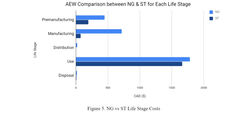 Economic Analysis AEW Graph for Water Heating Systems |  Hybrid Analysis Results from FCR |
|---|---|---|
 Impact Analysis Results from FCR |  Societal Analysis Results from FCR |  Natural Gas Water Heating Sensitivity Analysis from FCR |
 Solar Thermal Water Heating Sensitivity Analysis from FCR |

COMMUNICATION
Attribute developed through Preliminary Literature Review and the Final Presentation
PRELIMINARY LITERATURE REVIEW
One of the new things I came to learn through the writing of engineering documents was the importance of correctly sourcing any outside information used to prove claims, as well as being able to choose the right sources to use. In earlier documents, I looked at sources as simply proof that I did not make up important claims in my document. Through the Preliminary Literature Report and various workshops held by the University of Toronto Library staff and course communication leads, I came to realize it was much more than this. I learned that before putting in a source, you should follow a simple checklist to ensure its usefulness. This includes checking when it was published and by who, how relevant the information is to your needs, where the information came from, and determining whether bias may be present in the source. The Preliminary Literature Report allowed me to take a step back from the main document to focus on the skill of research. I found three sources from different mediums that served as significant to my main project and dissected them according to the CRAAP test (Found in Images Below). Along with the focus on research, the report also included a schedule I made together with my team to provide an overall timeline of important deadlines and their corresponding responsibilities. Overall, through this course and assignment I came to understand how significant detailed research is in industry and in design, and in the future will not take it as lightly.
 CRAAP Test used to check source credibility |  A Natural Gas Water Heating Source analyzed in my Preliminary Literature Report |  Part 2 of the Natural Gas Water Heating Source dissection |
|---|---|---|
 A Solar Thermal Water Heating Source analyzed for my Preliminary Literature Review |  Part 2 of the Solar Thermal Water Heating Source dissection |  The three Sources I analyzed in my Preliminary Literature Review in IEEE citation format |
 The course Schedule my Team and I made |
FINAL PRESENTATION
To conclude the main project for the course Design for Environment, my Team and I presented a 7 min presentation on our findings and final recommendations according to design for the environment strategies. The ability to successfully present my ideas to an audience such that a clear understanding of my effort and thoughts are portrayed is very important to me. I feel that there are many factors to a successful presentation and communication, including clear and illustrative backup media, an understanding of the material to be presented, the ability to clearly speak with confidence, and the ability to tailor the type of information and length according to your audience. I learned through this experience the importance of presenting the right material, or else the work you put in will become irrelevant to the viewers. The video below is a short portion of the presentation, specifically the introduction and conclusion in which I presented. I have included this video in my portfolio because I feel that it is not the very best that it could have been. I sometimes sounded unsure of what I was saying, was too fast in speaking, or sounded scripted. I find looking back at your work to be very important in determining what to work on, in order to improve in the future. I believe that being passionate about a project or design to be presented positively effects the outcome of a presentation. I will continue to practice my public speaking and presenting skills in the future and am sure to get better overtime. Some images from the presentation slides are included below.
 Final Presentation Slides |  Introduction and Background |  Motivation for the Report |
|---|---|---|
 Scope and System Boundary |  Chosen Design and Final Recommendations |

CONCLUSION
Thank you very much for you time! I hope this gave you a glimpse of some of the skills and attributes I am looking to improve on and develop during my academic career. My future goal is to create a difference in the world through Sustainability in the Aerospace industry! By applying the 12 attributes in my work, including the ability to communicate and recognize impacts on society and the environment, I will be able to take my place amongst the thousands of engineers focused on making this world a better place.
If you want to learn more about me and my four life goals, please feel free to check out the About Me page linked below!
Until Next time!
-Matilda Khoshaba